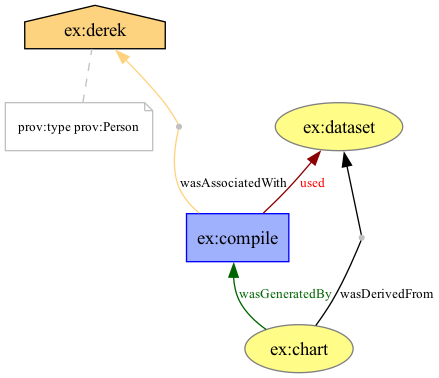
The PROV Python package now reads PROV-N, the notation used throughout the W3C PROV documents, so you can load it straight into Python, then draw it, convert it or build on it.
The PROV Python package finally reached 3.x this summer. Here is what changed, who I found using it (far more people than I expected), and why it is time to unpin 1.5.1 and 2.1.1.
Updated 12-Sep-2026: ProvStore was retired in December 2024, six years after this move. The links to both services below are kept as plain text. See the software page for its history.
With my move to a new institution, the ProvStore at
Southampton is no longer maintained.
In the recent months …
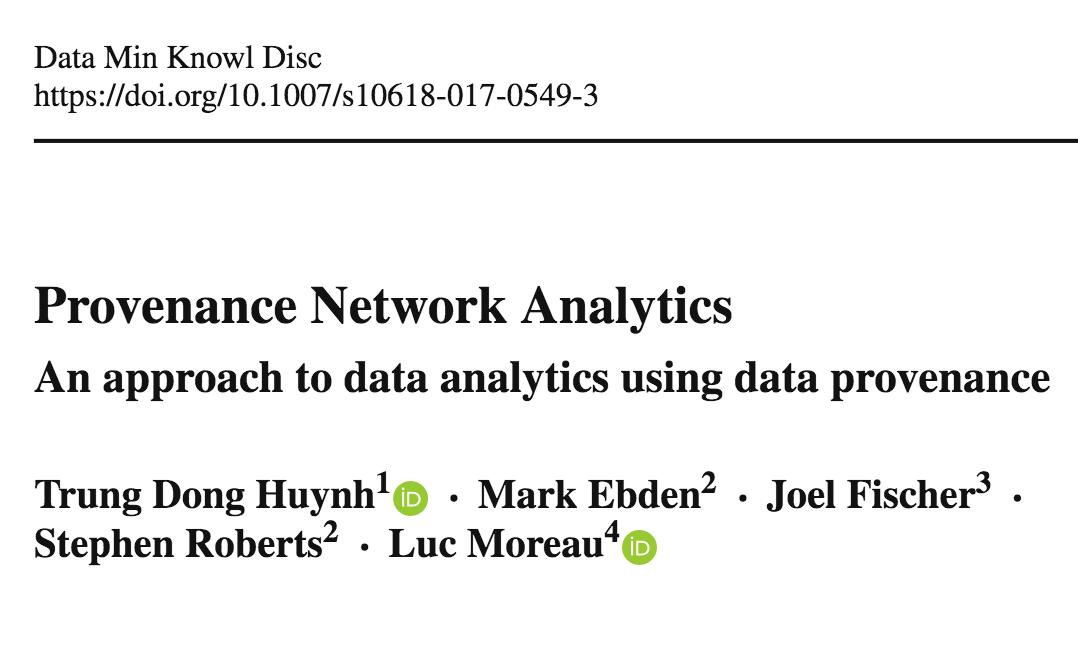
I am very pleased to announce that the above paper has been published in Springer's Data Mining and Knowledge Discovery journal. It presents a novel approach to analysing provenance information, combining provenance network metrics and machine learning; the main aim currently is to label data from analysing their provenance.
I am pleased to announce that, after over a year since Prov Python 1.4.0, a new version of PROV Python library, version 1.5.0, is now available from PyPI. Thanks to the significant contribution by Satrajit Ghosh, the library now supports RDF output and input (following the …
Documentation is hard work! I started the work on the PROV Python package nearly three years ago and yet its documentation is still quite lacking. As a small effort to make up for it, I thought a simple tutorial might help a bit.
After showing the TextMate PROV-N bundle to my colleagues, one pointed to me the powerful Ace code editor, which comes with tools to facilitate adding a new syntax. I found it even easier to work with compared to TextMate's bundle editor. After a day, I managed to port the PROV-N …